


 By
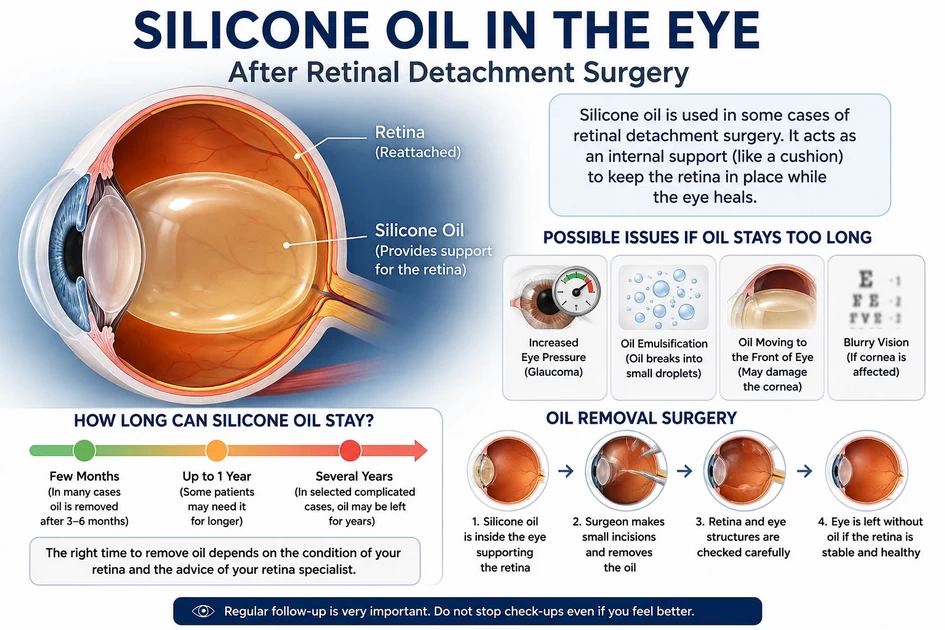
By Silicone oil is sometimes placed inside the eye during retinal detachment surgery. It helps support the retina and keep it in the correct position while the eye heals.
Many patients have an important question:
“How long can silicone oil stay inside the eye?”
There is no single answer for every patient. Some patients have the oil removed after a few months. In other patients, doctors may leave it for a year or even longer.
The decision depends on the condition of the retina, the type of surgery, the stability of the eye, and whether the silicone oil is causing any problems.
What is silicone oil?
Silicone oil is a special medical oil used inside the eye during some complicated retinal surgeries.
During retinal detachment surgery, the surgeon repairs the retinal tears or holes and tries to put the retina back into its normal position.
Silicone oil can then act as an internal support for the retina. It helps keep the retina attached while it heals.
Think of it like a temporary internal support.
The silicone oil does not strengthen the eye nerve. Its main purpose is to support the retina.
Why is silicone oil used?
Silicone oil may be used when the retinal problem is complicated or when the surgeon believes the retina needs long-term internal support.
For example, it may be used in some cases involving:
- complicated retinal detachment
- large or multiple retinal tears
- recurrent retinal detachment
- severe scar tissue around the retina
- some cases where gas is not the best choice
- situations where longer-lasting retinal support is needed
The exact reason depends on the patient’s eye condition.
Does silicone oil disappear naturally?
No.
This is an important difference between gas and silicone oil.
A gas bubble is gradually absorbed by the body. Silicone oil is not normally absorbed in the same way. If the surgeon decides that the oil should be removed, another procedure is usually required.
How many months can silicone oil stay in the eye?
There is no fixed rule such as:
“Silicone oil must always be removed after 6 months.”
Some patients may have it removed after several months.
Some patients may keep it for around a year.
In selected complicated cases, doctors may leave silicone oil for much longer.
The important point is that the removal time should be decided by the retinal surgeon, based on the condition of the eye.
Doctors must balance two things:
Benefit of keeping the oil
versus
Possible problems caused by keeping the oil for too long.
There is also no universally agreed single “perfect” time for silicone oil removal.
What can happen if silicone oil stays too long?
Silicone oil can be very useful, but it is not completely risk-free.
Keeping it inside the eye for a long period can be associated with complications.
1. Silicone oil can break into small droplets
This is called emulsification.
Instead of remaining as one large oil-filled space, the silicone oil can form many tiny droplets.
These droplets may move to different parts of the eye.
In some patients, emulsified oil may need to be removed.
2. Eye pressure can increase
Silicone oil can sometimes contribute to an increase in intraocular pressure.
High pressure inside the eye can lead to glaucoma.
If the eye pressure cannot be controlled adequately with treatment, the surgeon may consider removing the silicone oil.
This is one reason why regular eye-pressure checks are important.
3. Silicone oil can move toward the front of the eye
In some situations, oil can move into the front part of the eye.
If silicone oil comes into prolonged contact with the cornea, it can damage the corneal cells and affect corneal clarity.
The cornea is normally clear, like a transparent window at the front of the eye.
If it becomes cloudy, vision can become worse.
4. The retina can detach again after oil removal
This is an important point that patients should understand.
Removing silicone oil is not simply a matter of:
“Six months are over, so remove it.”
The surgeon first needs to decide whether the retina is stable enough.
Removing the oil too early or in an eye that still needs internal support may increase the risk of the retina becoming detached again.
Therefore, the surgeon must balance the benefits of removing the oil against the risk of recurrent retinal detachment.
Why do some patients keep silicone oil for years?
This may sound surprising, but there are cases where doctors intentionally leave silicone oil for a long period.
For example, if the retina has a very high risk of detaching again, the surgeon may decide that the benefit of continued oil support is greater than the benefit of removing it.
Therefore:
Long-term silicone oil does not automatically mean the surgery was unsuccessful.
It may be an intentional decision made because the eye needs continued support.
What happens when silicone oil is removed?
If the retinal surgeon decides that the oil can be removed, the patient usually needs another eye procedure.
During the procedure, the surgeon removes the silicone oil from inside the eye.
The doctor will also check the condition of the retina and other structures of the eye.
After removal, the eye still needs follow-up because there can be a risk of retinal problems returning.
Will vision immediately become normal after silicone oil removal?
Not necessarily.
This is a very important point.
Silicone oil is mainly used to support the retina. Removing the oil does not automatically repair damage that was already present in the retina or optic nerve.
Vision after surgery depends on many factors, including:
- how severe the original retinal detachment was
- whether the macula was damaged
- whether the retina remained attached
- whether there was scar tissue
- whether the optic nerve was damaged
- whether other parts of the eye were injured
- whether complications developed before or after surgery
Some patients may continue to have reduced vision even after successful retinal surgery.
Does silicone oil damage the optic nerve?
Silicone oil is primarily used to support the retina.
It is important not to confuse retinal support with nerve repair.
If the optic nerve was damaged because of an accident or another serious eye condition, silicone oil does not repair the damaged optic nerve.
The final visual result depends on the condition of the retina, optic nerve and other parts of the eye.
What symptoms should not be ignored?
A person with silicone oil in the eye should follow the retinal surgeon’s follow-up schedule.
Seek urgent medical attention if there is:
- severe or increasing eye pain
- sudden reduction in vision
- increasing redness
- severe headache with eye symptoms
- nausea or vomiting associated with eye pain
- new flashes of light
- a sudden increase in floaters
- a dark curtain or shadow appearing in the vision
Severe pain or sudden visual changes should not simply be assumed to be a normal effect of silicone oil. Eye pressure and the retina may need to be checked urgently.
Is 6 months too long?
Not necessarily.
Six months is not a universal deadline for silicone oil removal.
Some patients have their oil removed after several months, while others may need it for a year or longer.
The correct question is not:
“Has six months passed?”
The better question is:
“Is the retina stable enough for the oil to be removed, and is the oil causing any problems?”
That decision should be made by the patient’s vitreoretinal surgeon after examining the eye.
What should you ask your retina surgeon?
If you or a family member has silicone oil in the eye, these questions can be very useful:
- Why was silicone oil used in this eye?
- Is the retina completely attached now?
- Is the macula healthy?
- Is the eye pressure normal?
- Has the silicone oil started to emulsify?
- Is any oil moving into the front of the eye?
- Does the cornea look healthy?
- When do you recommend removing the oil?
- What is the risk of retinal detachment after removing it?
- What could happen if we leave the oil longer?
- Is the optic nerve damaged, or is the problem mainly with the retina?
- What level of vision can realistically be expected?
These questions can help the patient and family understand why the surgeon is recommending either removal or continued retention.
Final message
Silicone oil can be an important tool in complicated retinal surgery. It helps support the retina while it heals, but it is not something that must always be removed at exactly the same time for every patient.
Some eyes need the oil for only a few months. Some need it longer.
The decision depends on the individual eye.
Do not remove silicone oil simply because a certain number of months have passed. Do not leave it longer without medical follow-up either.
The safest approach is regular examination by a vitreoretinal specialist, who can check the retina, eye pressure, cornea and position of the oil and decide whether removal is appropriate.
Important: This article is for general patient education. It cannot replace an examination by an ophthalmologist. A person with severe eye pain, vomiting, sudden vision loss or increasing redness should seek urgent eye care.
How long can silicone oil stay in the eye?
Silicone oil may stay in the eye for several months, a year, or sometimes much longer. The timing depends on the condition of the retina and the patient’s individual situation.
Does silicone oil have to be removed after 6 months?
No. Six months is not a fixed deadline for every patient. Some patients need removal after several months, while others may need the oil for a longer period.
What happens if silicone oil is left in the eye too long?
Long-term silicone oil can sometimes cause problems such as increased eye pressure, oil emulsification, or corneal damage. Regular follow-up is important.