

 By
By Why Does Bread Medu Vada Become Crispy?
Imagine building a small brick house.
- Bread pieces are the bricks.
- Rice flour and corn flour are the cement.
- Curd is the water that binds everything together.
- Hot oil acts like a protective outer coating.
When the vada enters hot oil, the moisture inside turns into steam and escapes. At the same time, the starches from the bread, rice flour, and corn flour harden to form a crisp shell.
If there is too much moisture, the shell cannot form properly.
If there is too little moisture, the vada becomes hard and dry.
The correct balance creates the ideal texture—crispy outside and soft inside.
Ingredients
| Ingredient | Quantity | Purpose |
|---|---|---|
| Bread slices | 6 | Main base |
| Thick curd | ½ cup | Binding |
| Rice flour | 2 tbsp | Crispiness |
| Corn flour | 1 tbsp | Lighter crust |
| Rava | 2 tbsp | Extra crunch |
| Onion | 1 | Flavor |
| Green chilies | 2 | Spice |
| Ginger | 1 tsp | Aroma |
| Curry leaves | Few | South Indian flavor |
| Coriander | 2 tbsp | Freshness |
| Cumin | ½ tsp | Taste |
| Salt | As required | Seasoning |
| Hot oil | 1 tsp (optional) | Helps reduce oil absorption |
| Oil | For frying | Cooking |
Step-by-Step Procedure
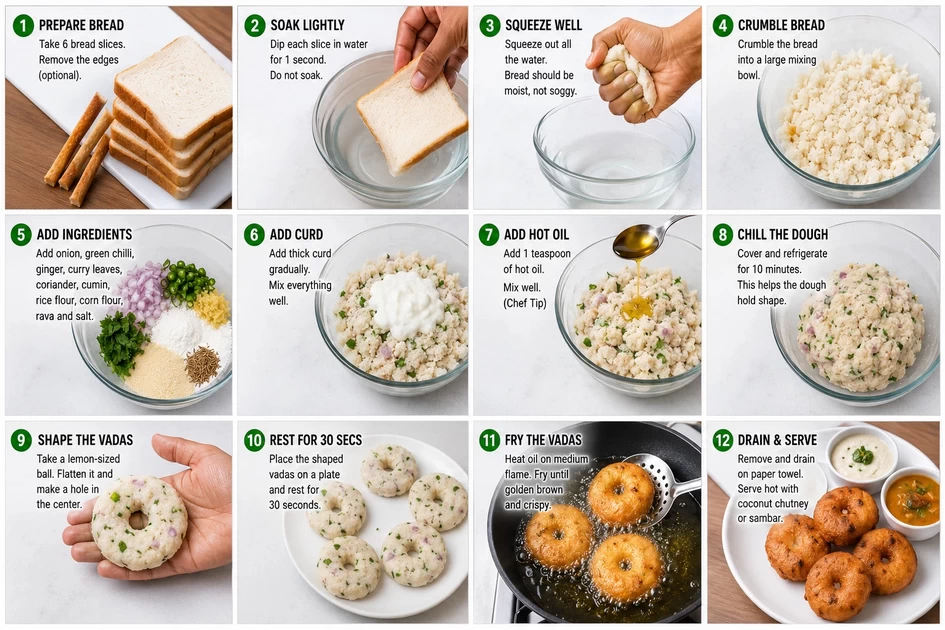
Step 1 – Prepare the Bread
Remove the edges if preferred.
Lightly dip each bread slice in water for just one second.
Immediately squeeze out the excess water.
The bread should be moist, not soggy.
Step 2 – Prepare the Dough
Crumble the bread into a large bowl.
Add:
- Rice flour
- Corn flour
- Rava
- Onion
- Green chilies
- Ginger
- Curry leaves
- Coriander
- Cumin
- Salt
Add thick curd gradually and mix into a soft dough.
Finally, add 1 teaspoon of hot oil taken carefully from the frying pan. Mix thoroughly.
This optional chef technique helps create a crisp surface and can reduce oil absorption during frying.
Step 3 – Chill the Dough
Cover the bowl and refrigerate for 10 minutes.
Why?
The dough firms up, becomes easier to shape, and is less likely to break in hot oil.
Step 4 – Shape the Vadas
Grease your hands lightly with oil.
Take a lemon-sized portion.
Flatten gently.
Create a hole in the center.
Allow the shaped vadas to rest for 30 seconds before frying. This helps the surface dry slightly for improved crispiness.
Step 5 – Fry the Vadas
Heat oil over medium flame (about 170–180°C).
Do not overcrowd the pan.
Fry until evenly golden brown.
Drain on kitchen paper before serving.
Optional Restaurant Double-Fry Technique
For an even crispier finish:
First Fry
Cook at approximately 160°C for 3 minutes.
Remove and rest for 2–3 minutes.
Second Fry
Return to hotter oil (around 180°C) for 45–60 seconds.
This technique creates a crisp exterior while keeping the center soft.
Chef’s Professional Tips
1. Chill Before Frying
A short chill helps the dough hold its shape and improves the final texture.
2. Use Thick Curd
Watery curd makes the mixture loose and increases oil absorption.
3. Crush the Spices
Rub curry leaves, cumin, and a few black peppercorns between your fingers before mixing. This releases their natural oils for a stronger aroma.
4. Add a Pinch of Sugar
About ¼ teaspoon enhances browning without making the vadas taste sweet.
5. Rice Flour + Corn Flour
Using both flours together often produces a lighter, crispier crust than using rice flour alone.
6. Avoid Overmixing
Mix only until combined. Excessive mixing can make the dough dense.
Common Problems and Solutions
Vada Breaks in Oil
Cause: Dough is too wet.
Solution: Add rice flour gradually until the dough holds together.
Vada Is Hard
Cause: Too much flour or too little moisture.
Solution: Add a spoonful of thick curd and mix gently.
Vada Absorbs Too Much Oil
Cause: Oil temperature is too low.
Solution: Fry at medium heat and avoid adding too many vadas at once.
Outside Brown, Inside Raw
Cause: Oil is too hot.
Solution: Lower the heat and fry for a little longer.
Not Crispy
Cause: Excess moisture or insufficient frying temperature.
Solution: Adjust the dough with a little extra rice flour and maintain the correct oil temperature.
Storage Tips
- Refrigerate uncooked dough for up to 24 hours.
- Fry just before serving for the best texture.
- Leftover vadas can be reheated in an oven or air fryer to restore some crispiness.
| Nutrient | Value |
| Calories | 120 kcal |
| Protein | 3 g |
| Carbohydrates | 16 g |
| Fat | 5 g |
| Fiber | 1 g |