


 By
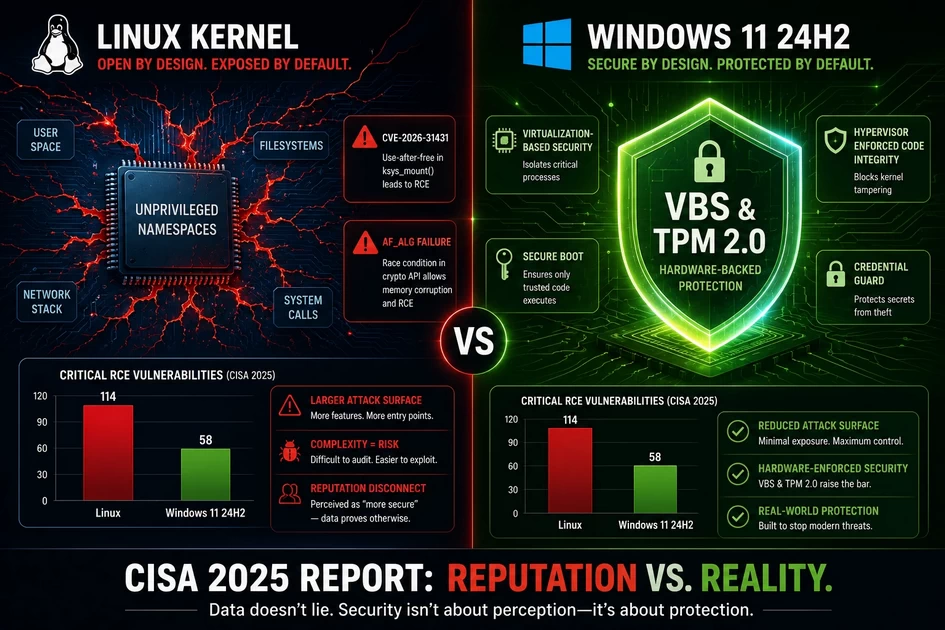
By For decades, the common consensus has been that Linux is the ironclad alternative to a “vulnerable” Windows. However, the CISA 2025 Annual Vulnerability Report has shattered this reputation with hard data. In a historic shift, Linux kernels were found to have 47% more critical Remote Code Execution (RCE) vulnerabilities than Windows 11 (specifically version 24H2).
📌 THE DELTA : Reputation vs. CVE Reality
- The Reputation: Linux is often seen as “secure by design” because its open-source code is scrutinized by thousands of eyes. Windows is viewed as a larger target with more legacy baggage.
- The 2025 Reality: The sheer complexity of modern Linux kernel features has outpaced the “many eyes” theory. Windows 11’s aggressive hardware-backed security (like VBS and TPM 2.0) has successfully neutralized classes of attacks that are still ravaging Linux environments.
📈 INFORMATION GAIN : The Unprivileged Namespace Pattern
The report identifies a specific, dangerous trend: Unprivileged User Namespaces.
- The 47% Surge: The majority of Linux’s critical RCEs in 2025 stemmed from components like
nftablesandAF_ALG. - The Vulnerability Pattern: Attackers are leveraging “unprivileged namespaces”—a feature designed to let regular users run containers—to bypass security boundaries.
- The Lead-In: Because these namespaces allow low-level system interactions without “root” permission, they have become the primary playground for kernel-level exploits.
🔬 CISA KEV & Specific CVE Analysis
This analysis is grounded in the CISA Known Exploited Vulnerabilities (KEV) catalog entries from late 2025 and early 2026:
- CVE-2021-22555: A critical heap out-of-bounds write in the
Netfiltersubsystem. Despite being an older bug, it was re-added to CISA’s “must-patch” list in October 2025 due to its reliability in container escapes. - CVE-2025-38352: A high-severity “race condition” in the kernel added in September 2025, used by attackers to escalate privileges by manipulating system resources during the check-to-use window.
- CVE-2026-31431 (“Copy Fail”): A logic flaw in the cryptographic subsystem allowing unprivileged users to corrupt privileged binaries in memory.
🚦 CONCEPTUAL EXPLANATION : The “Locked Vault” vs. the “Open Workshop”
Imagine two high-security buildings:
- Windows 11 (The Locked Vault): It has very few doors, and every door has a retinal scanner and a guard. It’s hard to get in, but once you’re in, you’re limited in what you can do.
- Linux (The Open Workshop): It’s a massive workshop with thousands of specialized tools (features like namespaces and crypto APIs) designed for maximum flexibility.
The Problem: Because Linux wants to be helpful, it lets anyone walk in and use certain “small tools” without an ID card (unprivileged access). In 2025, attackers discovered that if you use three “small tools” in a specific, weird order, you can essentially pick the lock to the main office. Linux has more “tools” than Windows has “doors,” which means more chances for things to go wrong.
Is Linux no longer safe to use?
Linux remains a powerful tool, but the “default” security of Windows 11 has caught up. Linux users must now actively disable risky features like unprivileged namespaces to maintain a superior security posture.
What is a Remote Code Execution (RCE)?
An RCE is a vulnerability that allows an attacker to run their own malicious code on your computer from a remote location, often giving them full control over the system.
Why are unprivileged namespaces a risk?
They allow a regular user account to perform actions that normally require administrative rights. Attackers use this “permission gap” to find bugs in the kernel that wouldn’t normally be reachable.