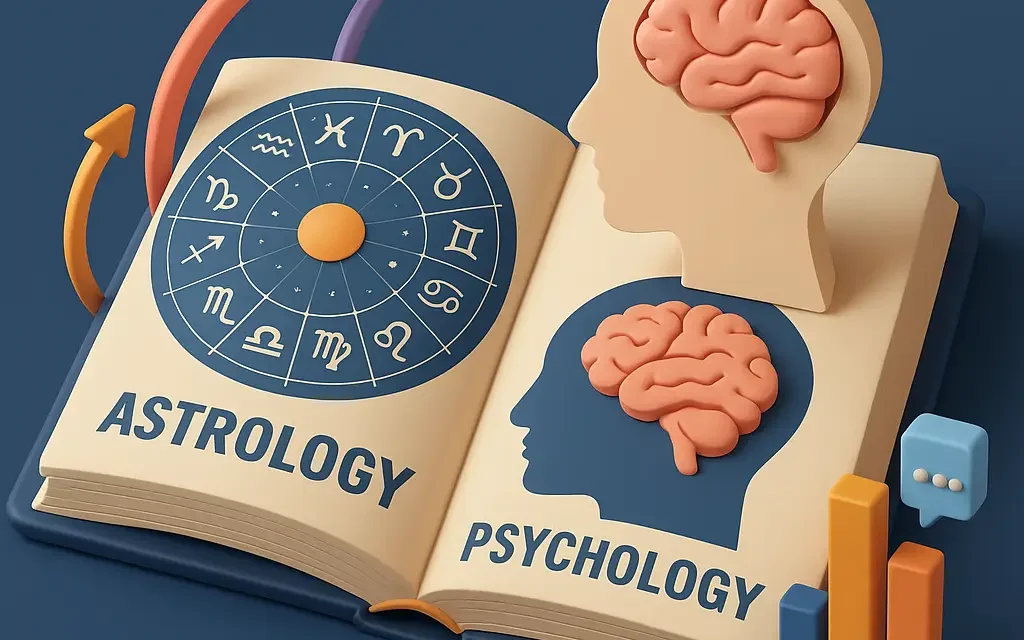
People everywhere use two tools when trying to understand themselves:
-
Astrology → symbolic, intuitive, pattern-based
-
Psychology → scientific, analytical, research-based
At first glance, they seem totally different.
-
Psychology deals with the mind, behavior, emotions, patterns, and mental processes.
-
Astrology deals with symbols, planets, zodiac signs, and life themes.
Yet millions of people find that astrology describes emotional tendencies, personality styles, and inner conflicts in a surprisingly relatable way.
This naturally creates questions:
-
Why does astrology feel psychologically accurate?
-
Is astrology a kind of early psychology?
-
Do zodiac signs represent personality patterns?
-
How does symbolism connect to real emotions?
To answer these questions, we must look at astrology and psychology as two different languages trying to describe the same human experience.
2. The Basic Concept: Astrology as a Symbolic Psychology System
Before modern psychology existed, ancient people still needed ways to:
-
Understand personality
-
Explain emotions and moods
-
Predict behavior
-
Understand relationships
-
Answer questions like “Why am I like this?”
So they used the sky as a giant mirror of human experience.
Astrology became a system that described:
-
Temperament
-
Emotional style
-
Energy patterns
-
Relationship patterns
-
Inner conflicts
-
Life phases
In modern terms, these are psychological descriptions.
⭐ Simple Explanation
Astrology = a symbolic map of human behavior
Psychology = a scientific study of human behavior
Both try to describe why people think, feel and behave the way they do.
⭐ Real-Life Analogy
Think of a weather app and a poem about rain.
-
A weather app uses numbers and data → like psychology
-
A poem uses metaphor and symbolism → like astrology
Both describe the same rain, but in different languages.
Similarly:
-
Psychology uses scientific terms like “introversion”, “attachment style”, “coping mechanism”
-
Astrology uses symbols like “Cancer energy”, “Moon in 7th house”, “Saturn return”
Both describe the emotional world, but with different tools.
3. Why Astrology Feels Psychologically Accurate
People often say:
“Why does my zodiac sign describe me so well?”
“Why do astrology personality patterns look real?”
There are four major reasons.
3.1 Reason #1 — Astrology Uses Archetypes: Universal Human Patterns
In psychology, Carl Jung introduced the concept of archetypes.
Archetypes are:
-
Universal characters
-
Repeated human patterns
-
Recurring personality styles
-
Emotional scripts
Examples:
-
The hero
-
The caretaker
-
The rebel
-
The explorer
-
The wise old man
-
The innocent child
Astrology signs closely match these archetypes.
Examples:
-
Aries → The Warrior
-
Taurus → The Stabilizer
-
Gemini → The Communicator
-
Cancer → The Caregiver
-
Leo → The Performer
-
Virgo → The Analyzer
-
Libra → The Diplomat
-
Scorpio → The Transformer
-
Sagittarius → The Philosopher
-
Capricorn → The Builder
-
Aquarius → The Visionary
-
Pisces → The Mystic
These archetypes are psychological patterns found in every culture.
So astrology sometimes feels accurate not because the planets control us,
but because archetypes are timeless human patterns.
⭐ Real-Life Analogy
A hero movie like “Lion King” or “Kung Fu Panda” works in every country.
Why?
Because the hero’s journey is a universal psychological story.
Astrology signs are also universal stories.
3.2 Reason #2 — Astrology Describes Emotional Styles
Astrology talks about:
-
How someone feels
-
How they express emotions
-
How they react under stress
-
How they relate to others
These are core topics in psychology too.
Example:
-
Fire signs → quick emotional expression
-
Water signs → deep emotional sensitivity
-
Earth signs → stable emotional grounding
-
Air signs → mental or logical emotional processing
This matches psychological temperament research like:
-
Big Five personality traits
-
Temperament theory
-
Emotional regulation styles
⭐ Real-Life Analogy
Some people show anger openly (fire).
Some store feelings silently (water).
Some ignore emotions and work hard (earth).
Some talk endlessly about feelings without feeling them deeply (air).
This isn’t “magic”—it’s emotion patterns, which psychology studies too.
3.3 Reason #3 — Astrology Provides a Framework for Self-Reflection
Astrology encourages self-observation:
“What are my strengths?”
“What are my weaknesses?”
“Why do certain relationships affect me more?”
“What triggers my emotions?”
This reflection is the foundation of psychology.
⭐ Simple Explanation
Astrology → mirror
Psychology → manual
Both help you see yourself better.
⭐ Real-Life Analogy
A fitness tracker gives data.
A mirror shows your physical form.
Both help you stay fit, but in different ways.
Astrology gives a symbolic mirror for the inner world.
3.4 Reason #4 — Astrology Speaks in Symbolism the Mind Naturally Understands
Human minds are naturally symbolic.
We understand our life through:
-
stories
-
metaphors
-
characters
-
symbols
Astrology uses symbols like:
-
Sun → identity
-
Moon → emotions
-
Mercury → thinking
-
Venus → relationships
-
Mars → action
-
Saturn → discipline
-
Jupiter → growth
Psychology uses similar symbolic frameworks:
-
Inner child
-
Inner critic
-
Ego
-
Shadow
-
Higher self
Symbolism is a universal human way of processing emotions.
⭐ Real-Life Analogy
When someone says:
“I feel heavy” or
“I’m carrying a burden”
They’re using symbolic language to describe psychological states.
Astrology is built entirely on symbols, so it connects deeply.
4. Astrology and Personality: Psychological Interpretation of Zodiac Signs
Zodiac signs are not scientific personality types, but symbolic personality archetypes.
Let’s break that down.
4.1 Fire Signs (Aries, Leo, Sagittarius)
→ Psychology keyword: High-energy temperament
They represent:
-
passion
-
action
-
confidence
-
impulse
-
creativity
Psychological match:
People with high dopamine sensitivity or extroversion may show similar traits.
Analogy:
Fire signs are like people who lead group projects, crack jokes, and bring energy into a room.
4.2 Earth Signs (Taurus, Virgo, Capricorn)
→ Psychology keyword: Grounded temperament
They represent:
-
practicality
-
routine
-
patience
-
stability
-
responsibility
Psychological match:
People with high conscientiousness or routine-seeking behavior.
Analogy:
The dependable coworker who shows up early and plans everything.
4.3 Air Signs (Gemini, Libra, Aquarius)
→ Psychology keyword: Cognitive temperament
They represent:
-
thinking
-
analysis
-
social interaction
-
communication
-
ideas
Psychological match:
People with curiosity, verbal intelligence, analytical thinking.
Analogy:
The friend who talks for hours about ideas, news, or concepts.
4.4 Water Signs (Cancer, Scorpio, Pisces)
→ Psychology keyword: Emotional temperament
They represent:
-
empathy
-
intuition
-
depth
-
sensitivity
-
imagination
Psychological match:
People with high emotional intelligence or emotional reactivity.
Analogy:
The friend who senses your mood without you saying a word.
5. Planetary Symbols as Psychological Archetypes
Astrology uses planets as symbols for mental processes.
Let’s translate each into psychology.
5.1 Sun → Identity & Core Personality
Psychology equivalent: Self-concept, ego, confidence
Analogy:
The “you” you show to the world.
5.2 Moon → Emotions & Childhood Patterns
Psychology equivalent: Attachment style, emotional regulation
Analogy:
How you react automatically when hurt.
5.3 Mercury → Thoughts & Communication
Psychology equivalent: Cognition, learning style
Analogy:
Your “mental operating system.”
5.4 Venus → Love Style & Preferences
Psychology equivalent:
Love languages, attraction patterns
Analogy:
Why you feel drawn to certain people.
5.5 Mars → Drive & Anger Expression
Psychology equivalent: Assertiveness, conflict style
Analogy:
How you push forward in life.
5.6 Jupiter → Growth, Beliefs, Confidence
Psychology equivalent: Optimism, meaning-making
Analogy:
Your “inner cheerleader.”
5.7 Saturn → Fear, Discipline, Boundaries
Psychology equivalent:
Defense mechanisms, long-term discipline
Analogy:
Your “inner strict teacher.”
6. Astrology as an Emotional Language
Astrology thrives because it translates emotions into a language people understand.
6.1 Example: Anxiety
Psychology calls it:
📘 Fight-or-flight, anticipation stress
Astrology calls it:
🌙 Moon tension, Mercury overthinking, Saturn fear
Both describe the same feeling using different tools.
6.2 Example: Relationship patterns
Psychology:
Attachment theory (secure, anxious, avoidant)
Astrology:
Venus signs, Moon signs, 7th house themes
Both explain how you love.
6.3 Example: Midlife crisis
Psychology:
Identity crisis around 35–45
Astrology:
Saturn return, Uranus opposition
Both describe a life restructuring phase with different languages.
7. How Astrology Can Support Psychological Growth (When Used Correctly)
Astrology should not replace therapy.
But it can support self-awareness in helpful ways.
7.1 It helps people ask deep questions
-
Why do I feel this way?
-
Why do I repeat these patterns?
-
What do I really want?
Questions = the beginning of psychological healing.
7.2 It gives language to emotions people cannot express
Example:
“I feel lost” → Pisces
“I feel pressured” → Saturn
“I feel restless” → Aries/Mars
Naming a feeling helps reduce its power.
7.3 It helps people see patterns
Astrology highlights:
-
repetitive emotional cycles
-
relationship patterns
-
strengths and weaknesses
-
hidden fears
-
inner motivations
This is similar to cognitive-behavioral therapy (CBT), which also identifies patterns.
7.4 It encourages self-acceptance
Example:
A Virgo person learning:
“It’s okay to want perfection. It’s your gift—but use it wisely.”
This reduces shame and increases emotional clarity.
7.5 It promotes reflection, journaling, and mindfulness
Many people use astrology prompts to reflect:
“What does my Moon sign need today?”
Reflection = therapeutic.
8. Astrology and Modern Psychology: Where They Meet
Let’s summarize the connection.
Astrology:
✔ Symbolic
✔ Emotional
✔ Archetypal
✔ Pattern-based
✔ Reflective
Psychology:
✔ Scientific
✔ Evidence-based
✔ Behavioral
✔ Cognitive
✔ Clinical
Where They Overlap:
-
personality types
-
emotional triggers
-
self-awareness
-
relationship patterns
-
identity
-
growth phases
-
inner conflict resolution
⭐ Real-Life Analogy
A therapist may say:
“You fear abandonment due to childhood patterns.”
An astrologer may say:
“Your Moon is sensitive and needs emotional security.”
Both address the same psychological need, but in different languages.
9. Conclusion: Astrology as a Mirror, Psychology as a Guide
Astrology does not predict your fate.
It describes:
-
your emotional language
-
your pattern tendencies
-
your inner conflicts
-
your style of relating
Psychology explains why those patterns exist.
When used together:
-
astrology becomes a symbolic map
-
psychology becomes the practical GPS
Astrology is the mirror of the inner world,
Psychology is the study of the inner world,
And together, they give a beautifully complete picture.