
(Updated for 2026 – Safe, Simple & Sustainable Guide)
Introduction: A Common Beginner Question
Many people want to start exercising but hesitate because they don’t have:
-
Gym access
-
Dumbbells or machines
-
Space for equipment
This leads to a common doubt:
“Is a home workout without equipment really enough?”
This article explains the real value and limits of no-equipment workouts, so beginners can start safely without unrealistic expectations.
What Public-Health Guidance Commonly Emphasizes
Across widely accepted public-health guidance, a few principles are consistent:
-
Physical activity does not require equipment to be beneficial
-
Bodyweight movement improves basic strength and mobility
-
Beginners should focus on consistency and safety
-
Simple movement patterns are effective
This means equipment is optional, especially at the beginner stage.
What Is a No-Equipment Home Workout?
A no-equipment workout uses:
-
Bodyweight
-
Gravity
-
Natural movement patterns
Common examples:
-
Squats, lunges, wall push-ups
-
Planks and balance movements
-
Stretching and mobility exercises
-
Walking or spot jogging
These movements train the body as a connected system, not isolated muscles.
Benefits of Home Workouts Without Equipment
✅ 1. Easy to Start
No purchases, no setup, no waiting.
You can begin immediately.
✅ 2. Lower Injury Risk for Beginners
Bodyweight exercises allow better control and gradual progression.
✅ 3. Improves Basic Strength & Mobility
Foundational movements support daily activities and posture.
✅ 4. Supports Long-Term Consistency
Simplicity reduces excuses and increases adherence.
Limitations of No-Equipment Workouts
Being honest is important.
❌ Limitations include:
-
Limited resistance for advanced strength
-
Slower muscle-building progress
-
Requires self-discipline
For beginners, these limitations are not a problem.
They become relevant only later.
Is a No-Equipment Workout Enough for Beginners?
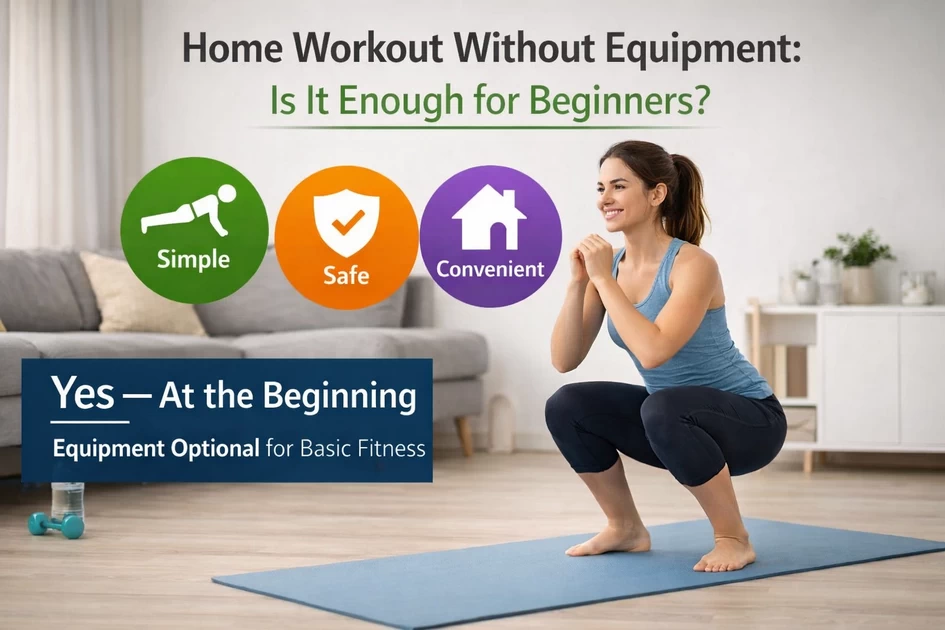
Short answer: Yes — at the beginning
A no-equipment home workout is enough to:
-
Improve movement habits
-
Build basic strength
-
Increase activity levels
-
Prepare the body for future progression
Many beginners benefit from starting simple and safe, then adding complexity later.
Home Workout Without Equipment vs Gym (Internal Link)
Where you exercise also matters.
-
No-equipment workouts are ideal at home
-
Gyms offer progression tools later
👉 Related guide:
Home Workout vs Gym: Which Is Better for Beginners?
How No-Equipment Workouts Fit with Walking or Running (Internal Link)
Cardio and movement often work best together.
-
Walking complements bodyweight workouts
-
Running may be added later if appropriate
👉 See also:
Walking vs Running: Which Is Safer and Better for Beginners
No-Equipment Workouts for Desk Workers (Internal Link)
Desk workers often benefit from simple movement routines.
-
Bodyweight mobility exercises
-
Stretching and posture-supporting movements
👉 You may also like:
Workout for Desk Workers: Reduce Back & Neck Pain Safely
How Often Should Beginners Do No-Equipment Workouts?
A commonly suggested approach:
-
Short sessions most days of the week
-
Focus on movement quality
-
Gradually increase duration
Consistency matters more than intensity.
Optional Tools That Can Help (Not Required)
Although equipment is not necessary, some beginners find these helpful:
-
Exercise mats
-
Fitness or habit-tracking apps
-
Simple timers
👉 Check beginner-friendly home workout tools here
(Affiliate links can be placed naturally)
What No-Equipment Workouts Will NOT Do
To keep expectations realistic:
-
They don’t provide instant results
-
They don’t replace medical care
-
They don’t guarantee muscle growth
They are a starting point, not a shortcut.
Final Recommendation
For beginners, home workouts without equipment are enough to start building a healthy exercise habit.
Progress comes from:
-
Regular movement
-
Safe routines
-
Gradual improvement
You don’t need equipment to begin —
you need consistency.
Health Disclaimer
Disclaimer:
This article is for general informational purposes only and reflects widely accepted public-health guidance. It does not replace professional medical or fitness advice. Consult a qualified healthcare or fitness professional before starting a new exercise routine.