When most people hear the word zodiac, they think of:
-
their sun sign
-
horoscopes
-
love compatibility
-
daily predictions
But behind all of that is something very real and very scientific:
The zodiac is based on astronomy – the actual path the Sun appears to travel through the sky and the constellations along that path.
In other words, before the zodiac became a tool for astrology, it was a way for ancient sky-watchers to measure the heavens.
1. What Is the Zodiac in Astronomy?
Before we talk about personality traits, elements and compatibility, we must ask a basic question:
What is the zodiac from a pure astronomy viewpoint?
1.1 The Sun’s Path: The Ecliptic
If you watch the Sun carefully every day at the same time, you’ll notice:
-
It does not rise and set at exactly the same point on the horizon.
-
Over the year, it slowly shifts north and south.
If you could draw the Sun’s apparent path against the background of distant stars across one full year, you would get a big circle in the sky.
Astronomers call this circle the ecliptic.
Analogy:
Imagine you are walking around a big circular track inside a stadium.
The houses around the stadium are like the stars – far away and fixed.
Your path around the track is like the ecliptic.
Wherever you stand on the track, different houses appear behind you in the background.
The ecliptic is the backbone of the zodiac.
1.2 The Zodiac Belt
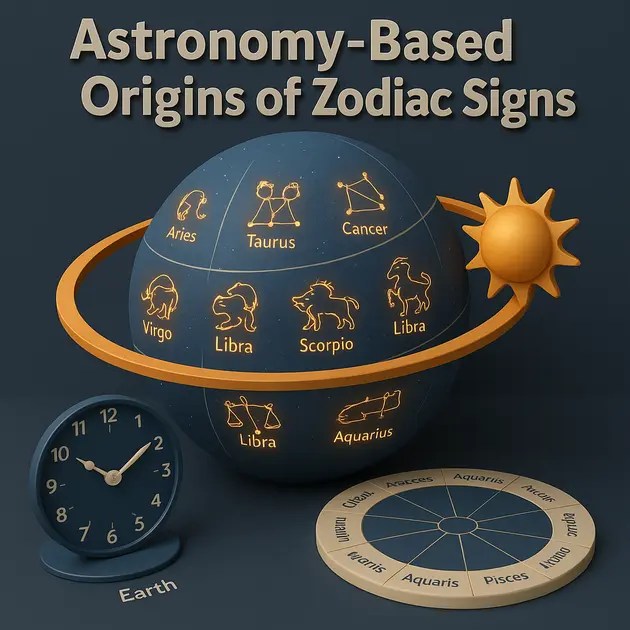
Along this ecliptic path, ancient astronomers noticed that the Sun, Moon and planets always stayed within a particular belt of the sky.
This belt, about 8–9 degrees above and below the ecliptic, is called the zodiac belt.
Within this belt, they recognised a set of star patterns (constellations). Over time, they chose 12 main constellations to divide the ecliptic into 12 equal parts.
Those twelve are the zodiac constellations.
-
Aries
-
Taurus
-
Gemini
-
Cancer
-
Leo
-
Virgo
-
Libra
-
Scorpio
-
Sagittarius
-
Capricorn
-
Aquarius
-
Pisces
From a scientific angle, these are simply groups of stars along the Sun’s apparent path.
From an astrological angle, they later became zodiac signs with meanings.
2. Why Exactly 12 Zodiac Signs?
2.1 12 Months, 12 Sections
Ancient civilizations such as the Babylonians were extremely good sky observers. They noticed that:
-
One full cycle of seasons (one year) takes about 12 Moon cycles.
-
It feels natural to divide the year into 12 months.
So they divided the 360° circle of the ecliptic into 12 equal segments of 30° each.
Analogy:
Think of a clock. One full circle is 12 hours.
Each hour is a neat, equal slice.
Early astronomers did something similar with the sky:
one full circle = 360°, divided into 12 pieces = 30° each.
Each 30° segment was given the name of a constellation in that region.
Even though the constellations in the sky are not exactly equal in size, for calculation they treated them as equally spaced signs.
This is why we say:
-
Aries = 0° to 30°
-
Taurus = 30° to 60°
-
Gemini = 60° to 90°
… and so on, around the full 360°.
2.2 The Babylonian Choice
Historical evidence suggests that around 2,500–3,000 years ago, Babylonians:
-
Already had a system of star catalogues
-
Used constellations as a calendar and clock
-
Selected 12 constellations along the ecliptic as a standard zodiac
These constellations were not “invented from nothing.”
They were chosen because people could easily recognise the shapes or connect them to familiar animals and objects.
For example:
-
A pattern that looked like a ram → Aries
-
A pattern that looked like a bull → Taurus
-
Two bright stars side by side → Twins → Gemini
The zodiac signs we use today in Western astrology still follow this Babylonian framework, refined later by the Greeks and others.
LSI keywords here:
Babylonian zodiac, 12-part division of ecliptic, ancient origins of zodiac signs, why 12 zodiac signs, astronomical basis of zodiac belt
3. The Astronomy Behind Each Zodiac Sign
Now let’s connect each zodiac sign to its astronomy-based origin – in simple language.
A key point:
In astronomy, zodiac signs are basically 30° segments of the ecliptic, starting from a specific reference point.
3.1 The Starting Point: Aries and the Spring Equinox
In the tropical zodiac (used in most Western astrology), the zodiac begins at the March equinox.
The March equinox is the moment when:
-
Day and night are nearly equal in length
-
The Sun crosses the celestial equator going north
Astronomers mark this point as 0° Aries.
Originally, thousands of years ago, when this system was set up:
-
At the March equinox, the Sun appeared in front of the constellation Aries.
So they decided:
“We will call this point Aries 0°, and from here, we divide the ecliptic into twelve equal 30° segments.”
From a physical astronomy perspective:
-
The Aries point is simply a direction in space, defined by Earth’s orbit and tilt.
-
From an astrology perspective, Aries became the sign of beginnings, energy, action, matching the spring season in the Northern Hemisphere.
Analogy:
Think of marking “0 km” on a road – a starting milestone.
The milestone itself doesn’t cause anything magical, but it becomes a reference point for all other distances.
Aries 0° is like that zero point for measuring the zodiac circle.
3.2 Signs as 30° Segments, Not Exact Star Shapes
It’s useful to remember:
-
Constellations are uneven in size and shape.
-
Zodiac signs are equal 30° sections, based on the Sun’s path, not on the exact size of star patterns.
So:
-
The constellation of Virgo in the sky is much wider than 30°,
-
but the sign of Virgo in astrology is exactly one 30° slice, from 150° to 180° of the zodiac circle.
Astronomy cares about the actual star positions.
Astrology uses a neat mathematical division for easier calculation and symbolism.
4. Seasonal Meaning: How Nature Shaped Zodiac Symbols
One of the most powerful astronomy-based origins of zodiac signs is the connection to seasons in the Northern Hemisphere.
Ancient people were mostly:
-
Farmers
-
Shepherds
-
Sailors
So their sky system naturally reflected seasonal life.
Let’s go around the zodiac and see how each sign links to the Sun’s position in the year and to natural cycles.
Note: This follows the tropical zodiac, which ties signs to seasons rather than the current constellations.
4.1 Aries (March–April): The Ram and New Beginnings
When the Sun enters Aries (0°):
-
In the Northern Hemisphere, it’s spring.
-
Seeds start to sprout, animals become more active, fire and energy return after winter.
The ram symbol:
-
Rams are strong, head-first animals.
-
They charge and push forward.
So Aries became associated with:
-
Starting energy
-
Action
-
Courage
-
Impulsiveness
Astronomy link: Aries begins at the spring equinox, when the Sun moves northward and light increases.
Analogy:
Think of the first day of school or the first day of a new job.
There is excitement, maybe impatience, and a desire to jump in.
That’s the Aries feeling.
4.2 Taurus (April–May): The Bull and Stabilizing Energy
As the Sun moves further into spring, it enters Taurus:
-
Nature becomes solid and stable.
-
Plants grow leaves, fields turn green, food becomes more visible.
The bull:
-
Slow, strong, connected to land and farming.
-
Represents work, stability and physical comfort.
So Taurus reflects:
-
Patience
-
Building things slowly
-
Love of material comfort
-
Connection to body and senses
Astronomy link: The Sun is higher in the sky; days are warmer and more settled.
Analogy:
After you start a new project (Aries), you must slow down and build systematically – like saving money every month. That is Taurus energy.
4.3 Gemini (May–June): The Twins and Communication
When the Sun enters Gemini:
-
Spring is turning towards summer.
-
Weather allows more movement and trade.
-
People can travel, exchange goods and news.
The twins symbol:
-
Represents interaction, talking, exchanging ideas.
So Gemini is linked with:
-
Communication
-
Curiosity
-
Learning many things
-
Quick changes
Astronomy link: The Sun’s path moves towards the June solstice, the longest days.
Analogy:
Imagine exam time is over, and now you are free to visit friends, talk, explore. The social, chatty mood is very Gemini.
4.4 Cancer (June–July): The Crab and Home
At Cancer, the Sun reaches the June solstice:
-
The longest day in the Northern Hemisphere.
-
After this, days slowly start to shorten.
The crab symbol:
-
Lives near the boundary of water and land.
-
Moves sideways, has a protective shell.
Cancer became associated with:
-
Home
-
Family
-
Emotional protection
-
Nurturing
Astronomy link: At the solstice, the Sun seems to pause (“turn back”) in its northward journey, just like a crab pausing and moving sideways.
Analogy:
Like coming home after a long trip and wanting comfort, food and family – that protective, caring feeling is Cancer.
4.5 Leo (July–August): The Lion and Creative Fire
In Leo, the Sun is strong:
-
It’s the heart of summer.
-
Fields are full, light is intense.
The lion symbol:
-
King of animals
-
Represents royalty, pride, courage
So Leo is linked with:
-
Creativity
-
Leadership
-
Self-expression
-
Joy and play
Astronomy link: The Sun is at high strength; its heat is obvious.
Analogy:
Think of a school annual day where students get on stage, dance, act, show their talents. That spotlight moment is Leo.
4.6 Virgo (August–September): The Maiden and Harvest
As the Sun moves into Virgo:
-
Farmers start thinking about harvest.
-
It’s time to sort grains, separate good from bad, plan storage.
The maiden with wheat symbol:
-
Represents careful work, selection, detail and service.
So Virgo represents:
-
Analysis
-
Precision
-
Practical help
-
Health and organisation
Astronomy link: The Sun is moving towards the September equinox, where summer turns into autumn.
Analogy:
Imagine cleaning your room after a big party: sorting things, folding clothes, putting items in proper place. That practical, detail work is Virgo.
4.7 Libra (September–October): The Scales and Balance
At Libra, we hit the autumn equinox:
-
Day and night are equal again.
-
After this, nights become longer.
The scales symbol:
-
Represents balance, fairness, justice.
Libra relates to:
-
Relationships
-
Equality
-
Harmony and beauty
Astronomy link: The equinox is a natural symbol of balance—equal day and night.
Analogy:
Think of managing two sides of a see-saw so they are level – or trying to balance work and family time. That balancing act is Libra.
4.8 Scorpio (October–November): Depth and Transformation
In Scorpio, autumn deepens:
-
Leaves fall
-
Nature begins to decay, preparing for winter
-
Life goes underground
The ancient Scorpio symbol (scorpion or eagle):
-
Represents danger, intensity, hidden power, transformation.
Scorpio themes:
-
Emotional depth
-
Secrets
-
Endings and beginnings
-
Psychological transformation
Astronomy link: The Sun’s path moves into darker, colder months; daylight reduces noticeably.
Analogy:
Like going through a tough breakup or a big life change that forces you to grow. Painful on the surface, but transformative inside – very Scorpio.
4.9 Sagittarius (November–December): The Archer and Quest
Approaching winter, the Sun enters Sagittarius:
-
Crops are harvested.
-
Travel, trade and learning become focus areas.
The archer centaur symbol:
-
Half-horse (instinct), half-human (mind), shooting an arrow upward.
-
Represents a search for meaning, philosophy, long journeys.
Sagittarius is linked with:
-
Exploration
-
Travel
-
Big ideas
-
Optimism and adventure
Astronomy link: The Sun’s path heads towards the December solstice; festivals of light and hope appear in many cultures.
Analogy:
Like planning an overseas trip or joining a big course that opens your mind – this expansion energy is Sagittarius.
4.10 Capricorn (December–January): The Goat and Climbing
At Capricorn, we reach the winter solstice:
-
Shortest day, longest night in Northern Hemisphere.
-
From here, light slowly begins to grow again.
The sea-goat symbol:
-
Goat that climbs steep mountains, yet with mythical tail.
-
Represents discipline, ambition, and responsibility.
Capricorn is tied to:
-
Hard work
-
Long-term goals
-
Structure and authority
Astronomy link: Light begins to increase again, but winter work is tough; survival depends on planning.
Analogy:
Think of preparing for a difficult exam or saving for a long-term goal like a house. Slow, disciplined climb = Capricorn.
4.11 Aquarius (January–February): The Water Bearer and Community
Moving forward, the Sun enters Aquarius:
-
Deep winter, but signs of coming spring appear slowly.
-
Communities traditionally gathered and shared resources.
The water bearer symbol:
-
Person carrying a pot of water to share.
-
Represents community, innovation, new ideas.
Aquarius themes:
-
Friendship
-
Social causes
-
Technology and future thinking
-
Individuality
Astronomy link: Looking ahead to spring; planning for the future after the darkest part of the year.
Analogy:
Like a group of friends planning a new project or startup that could change things – forward-looking and experimental. That’s Aquarius.
4.12 Pisces (February–March): The Fishes and Letting Go
Finally, the Sun reaches Pisces:
-
The last sign before the next spring equinox.
-
Nature is quietly preparing for a new cycle.
The two fishes symbol:
-
Swimming in opposite directions, tied together.
-
Symbolises intuition, imagination, spiritual connection, confusion, endings.
Pisces represents:
-
Dreams
-
Compassion
-
Sensitivity
-
Release and surrender
Astronomy link: End of the yearly cycle, just before Aries and the new cycle of seasons begin again.
Analogy:
Like the final days before you move to a new city: you feel emotional, nostalgic, half here and half already in your next life. That in-between state is Pisces.
5. Tropical vs Sidereal Zodiac: Astronomy Detail Made Simple
When people search for “astronomy-based origins of zodiac signs”, they often meet a confusing topic:
Tropical zodiac vs sidereal zodiac
Let’s make it very simple.
5.1 Earth Wobbles: Precession of the Equinoxes
Earth is like a spinning top:
-
It spins on its axis once a day (giving us day and night).
-
The axis itself slowly wobbles over about 26,000 years.
This wobble causes the equinox points (like 0° Aries) to slowly shift against the background of distant stars. This effect is called precession of the equinoxes.
Analogy:
Take a spinning top and give it a push.
The top spins fast, but the handle traces a slow circle.
Earth does the same thing with its axis.
Because of this, today:
-
The March equinox point (0° Aries in the tropical zodiac) no longer sits in front of the constellation Aries.
-
It has shifted into the constellation Pisces from an astronomical view.
5.2 Tropical Zodiac (Season-Based)
The tropical zodiac:
-
Used in Western astrology.
-
Fixes 0° Aries at the spring equinox, no matter which constellation is behind it.
-
Always keeps the signs locked to seasons:
-
Aries = spring beginning
-
Cancer = summer start
-
Libra = autumn start
-
Capricorn = winter start
-
This is more about Earth–Sun relationship and seasonal cycles.
5.3 Sidereal Zodiac (Star-Based)
The sidereal zodiac:
-
Used in many forms of Vedic/Indian astrology.
-
Tries to align signs with the actual constellations in the sky.
-
Uses a different zero point, adjusted for precession.
So in sidereal systems:
-
The Sun may be considered in sidereal Aries a few weeks later than in the tropical system.
Both systems come from astronomy:
-
Tropical → based on Earth’s tilt and seasons.
-
Sidereal → based on fixed star positions and constellations.
They simply measure the sky in different ways.
6. From Astronomy to Personality: How the Science Became Symbolism
We’ve seen how:
-
The zodiac signs are based on Sun’s path and seasons.
-
The animals and symbols match what people saw in nature during those times.
-
The circle was divided into neat 12×30° segments for easy calculation.
So how did all this become a tool for personality analysis and horoscopes?
6.1 Observing Patterns in Human Life
Ancient people noticed:
-
Certain people born in spring were more active and energetic.
-
Others born in harvest time were more careful and practical.
These are observational and cultural patterns, not scientific proof.
Still, over centuries, these ideas solidified into astrological meanings for each sign.
Analogy:
If you live in a very hot region, people might say “children from here are tough and used to heat.”
It’s not absolute science, but a general pattern people observe.
6.2 Assigning Elements and Modalities
Later, astrologers added layers:
-
Four elements: Fire, Earth, Air, Water
-
Three modalities: Cardinal, Fixed, Mutable
These were philosophical ways to group the 12 signs into energetic patterns, all still grounded in the seasonal cycle created by astronomy.
Example:
-
Aries (spring start) → Fire + Cardinal → new burst of energy
-
Taurus (spring middle) → Earth + Fixed → stable growth
-
Gemini (spring end) → Air + Mutable → changeable, talkative, windy energy
The astronomy-based cycle of nature thus became a symbolic cycle of personality and life themes.